
4 Inch Hydraulic Hose Crimping Machine Guide
A practical guide for understanding large hose crimping, judging real workshop needs, improving daily assembly habits, and choosing a suitable 4-inch crimping solution.
A 4-inch hose assembly looks simple from a distance. There is a hose, a fitting, a ferrule, a die set, and one crimping cycle. However, real workshop work is more demanding. Large hydraulic hose is heavy, stiff, and difficult to position. Therefore, choosing a hydraulic hose crimping machine should start with the way the hose is handled, not only with the largest number on a specification sheet.
In a repair workshop, a large hose may arrive from an excavator, loader, press, marine system, or industrial power unit. The old hose is often dirty and stiff. The new fitting may be bulky. Meanwhile, the work area may already be crowded with hose reels, tools, and finished assemblies.
At that moment, a stable crimping station feels different. The hose has room to enter straight. The fitting can be checked before pressure is applied. The operator can confirm insertion depth, choose the right die, and measure the result without rushing. This is the real value behind a 4-inch machine.
How large hydraulic hose crimping works
First, the basic principle is controlled compression. A die set closes around the ferrule and presses it onto the hose and fitting. As the ferrule becomes smaller, it grips the hose structure and locks the fitting in place. Therefore, a good crimp depends on force, tooling, alignment, and preparation at the same time.
However, 4-inch hose work adds more resistance. The hose wall is thicker. The reinforcement is stronger. The fitting is larger. Meanwhile, the hose body may pull downward during positioning. As a result, the machine needs enough opening, enough force, and enough stability to keep the assembly straight during the cycle.
In simple terms, crimping is not just “pressing harder.” It is controlled forming. The die must close evenly. The hose must be inserted to the correct depth. The ferrule must match the hose and fitting. In addition, the final crimp diameter should be measured after the machine opens.
This is why a large-hose station needs process thinking. The machine provides the force, but the process creates the result. Clean cutting, proper skiving, stable support, die management, and final inspection all influence whether the finished hydraulic hose assembly is reliable.
Simple workshop explanation
A good crimp should feel controlled from start to finish. The hose enters straight. The fitting does not shift. The die closes smoothly. The final measurement matches the target value.
If the job feels forced, the issue may not only be the machine. It may come from a rough cut, wrong die set, limited clearance, poor insertion depth, or a cramped workstation.
When 4-inch capacity really matters
In real work, 4-inch capacity usually appears in heavy equipment, industrial plants, mining machinery, port equipment, marine hydraulics, agricultural machinery, and large hydraulic power units. These applications often require hoses with larger flow demand and stronger reinforcement. Therefore, the crimper must handle both size and resistance.
The first visible sign is handling difficulty. A small hose can be moved, marked, and positioned quickly. However, a large hose may need bench support or floor support before the fitting reaches the crimping head. If the hose is fighting the operator, the station needs more space and more suitable equipment.
The second sign is fitting size. Some hoses may fall within capacity by nominal diameter, but the fitting body can still require more opening. For example, long ferrules, elbow fittings, and flange-style connectors may need extra clearance. Therefore, the largest real assembly should be checked, not only the hose size.
The third sign is work frequency. If 4-inch assemblies appear only once or twice a year, a different equipment strategy may be enough. However, if large hoses appear every week, a 4 inch hydraulic hose crimping machine can reduce waiting time, rework, and unsafe handling.
How to judge the right machine without relying on parameters only
Parameters are useful, but they do not describe the whole working experience. A workshop needs to know whether the machine can handle the actual hose program smoothly. Therefore, the best judging method starts with the real hose list.
First, list the largest hose size, the most common hose size, and the smallest hose size used in daily work. This shows whether the machine will mainly process large assemblies or mixed sizes. If most work is small and only some jobs are 4-inch, die change speed and station organization become important.
Next, check the fitting style. Straight fittings are usually easier to position. Elbows, long ferrules, and bulky connectors need more attention. In many cases, the fitting shape creates more difficulty than the hose itself.
Then, check the work rhythm. A repair workshop needs flexibility. A production line needs repeatability. A field service base needs fast turnaround and stable support for heavy assemblies. Therefore, the right choice should match the work rhythm, not only the largest diameter.
1. Check the largest real assembly
Look at hose size, ferrule length, fitting body, elbow shape, and clearance near the crimping head.
2. Check the most common size
A machine should handle the largest hose, but it should also feel efficient for common daily work.
3. Check the real work scene
Production, repair, and service support all need different levels of speed, flexibility, and stability.
Why cutting and skiving affect the final crimp
A strong crimper cannot correct every preparation problem. If the hose end is rough, angled, dirty, or damaged, the fitting may not sit correctly. As a result, the final crimp can become inconsistent even when the machine has enough force.
For that reason, clean cutting is the first quality step. A clean cut helps the fitting enter straight. It also reduces loose debris and wire damage. In large hose work, this matters more because the hose wall is thicker and the reinforcement is harder to trim by hand.
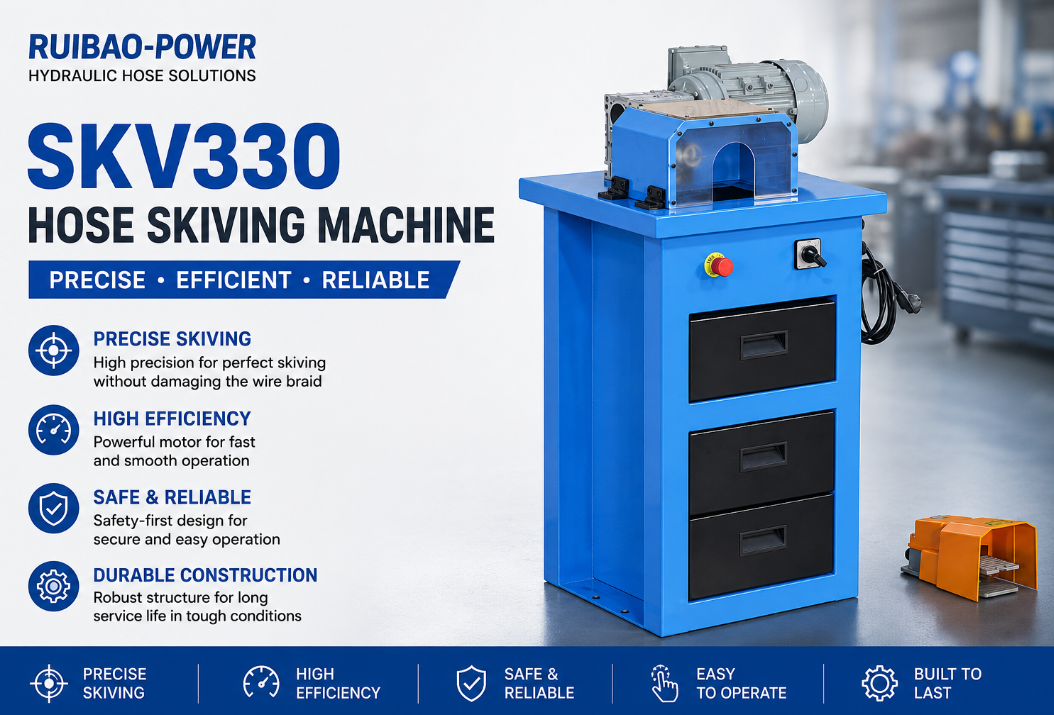
Skiving is another preparation step. Some hose and fitting combinations require the outer cover or inner layer to be removed before crimping. This should follow the hose and fitting specification. If skiving is too shallow or too deep, the assembly may lose consistency.
Therefore, a complete large-hose station should not only include the crimper. It should also include a suitable cutting machine, skiving machine when required, cleaning tools, die storage, measurement tools, and a clear work sequence.

Experience tips for more stable large-hose assembly
In daily work, small habits often decide whether large-hose crimping feels smooth or stressful. First, keep the die set clean and clearly marked. Similar die sizes can look close during busy shifts. Therefore, labels and fixed storage reduce mistakes.
Second, mark the insertion depth before crimping. This simple mark shows whether the fitting has moved during handling. When a heavy hose pulls backward, the mark gives an immediate visual check.
Third, support the hose body before the crimping cycle. A large hose should not hang from the fitting. If the hose weight pulls downward, alignment can shift. Therefore, a support stand, bench edge, or roller table can make the process more stable.
Finally, measure the final diameter after setup and during repeated work. A ferrule may look neat from the outside, but measurement confirms whether the crimp meets the target. This habit is especially useful in batch work, where small changes can repeat many times.

P120L and P140L: match the model to the scene
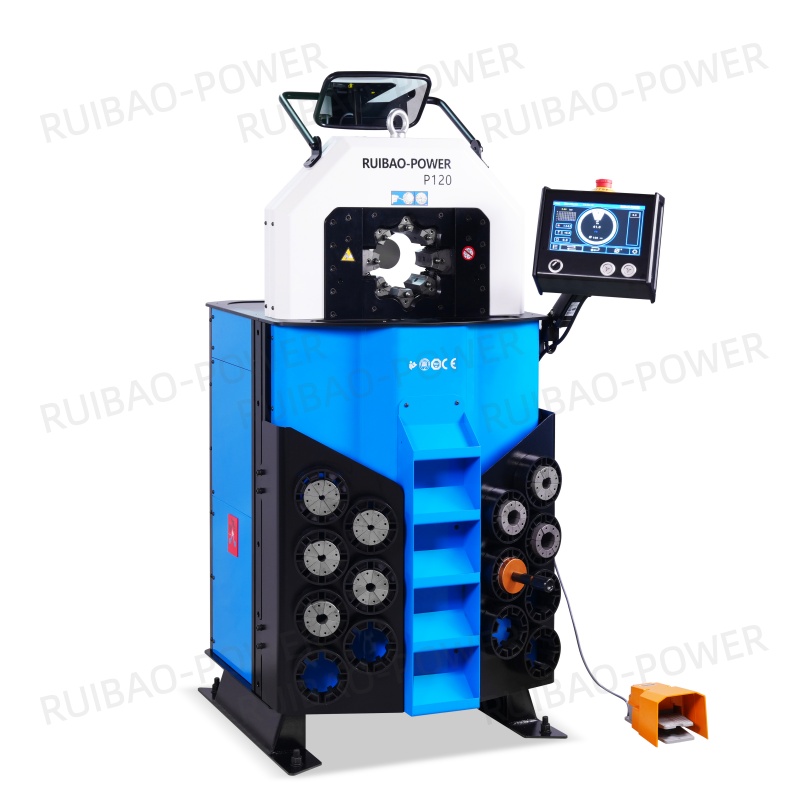
After the principle and work scene are clear, model selection becomes easier. Ruibao Power’s P120L 4-inch production crimper and P140L heavy-duty 4-inch crimper both support large hose work, but they fit different expectations.
The P120L is suitable when the workshop needs 4-inch capability with a more balanced production layout. It can support large, medium, and small hose connector work. Therefore, it is a practical direction for fixed workshop stations, production support areas, and maintenance rooms that handle regular large-hose jobs.
The P140L is more suitable when heavy-duty work appears often. It offers a stronger operating margin and a larger working range. As a result, it is a better direction when large fittings, wider clearance, and frequent heavy assemblies are part of the normal schedule.
However, neither model should be chosen only by looking at one parameter. The better method is to compare the largest assembly, the most common assembly, the available space, and the required production rhythm.
Choose P120L when...
The station needs balanced 4-inch capacity, regular mixed-size work, stable daily operation, and a practical fixed workshop layout.
Choose P140L when...
The station handles heavier fittings, frequent large assemblies, wider clearance needs, and more demanding production or service work.

Workshop workflow: the part many teams underestimate
A good 4-inch crimping station should feel open and predictable. The hose should enter the machine without sharp bending. The fitting should sit straight. The die set should be close enough to reach, but stored safely enough to avoid damage.
First, the feed direction needs room. Large hoses do not bend easily, so the machine should not be trapped in a tight corner. If the hose must be forced into position, the final alignment can suffer before crimping even starts.
Second, cutting and skiving should be close but not messy. These steps create debris. Therefore, the preparation area should be near the crimper, while the crimping head, fittings, and dies should stay clean.
Third, the measurement area should be part of the same station. Calipers, work instructions, crimp charts, and marking tools should sit within reach. If measurement is inconvenient, it may be skipped during busy work.
Finally, finished assemblies need a clear exit path. After crimping, the hose may need capping, tagging, pressure testing, or packing. A clean exit path prevents finished hoses from mixing with raw hose, loose fittings, or work waiting for inspection.
Practical layout tip
A simple left-to-right flow often works well: raw hose storage, cutting, skiving when needed, fitting insertion, crimping, measurement, and finished assembly staging.
This layout reduces backtracking. It also keeps heavy hose movement away from crowded work areas.
Scene-based selection examples
For a repair workshop, flexibility is often the main concern. Hose sizes change throughout the day. Some assemblies are small and quick. Others are large and urgent. Therefore, the station should support fast die changes, clear measurement, and enough space for unexpected large jobs.
For a factory maintenance room, repeatability matters more. The same machinery may use similar hose assemblies again and again. In this scene, saved settings, stable pressure, and organized records help replace assemblies with less guesswork.
For a production line, rhythm becomes critical. A crimper may process repeated batches for long periods. Therefore, machine stability, heat control, die management, and operator comfort all influence daily output.
For a field service base, large-hose work often returns to a fixed workshop. Smaller urgent repairs may use mobile equipment, but large 4-inch assemblies usually need stronger support and safer handling. Therefore, a fixed 4-inch station can become the backbone of service work.
Common mistakes when choosing a 4-inch crimper
The first mistake is choosing by maximum hose size only. Maximum size is important, but it does not show fitting clearance, actual working comfort, die coverage, or daily operation speed. Therefore, the largest real assembly should be checked.
The second mistake is ignoring the most common hose size. A machine may be selected for rare 4-inch work, but most daily work may be 1-inch, 1.5-inch, or 2-inch assemblies. In that case, the machine should still feel efficient for common jobs.
The third mistake is not planning the preparation process. Poor cutting and inconsistent skiving create problems before crimping begins. Therefore, the crimper, cutting machine, skiving machine, and measurement area should be planned as one system.
The fourth mistake is treating dies as simple accessories. Dies are precision tools. If they are dropped, mixed, dirty, or poorly stored, the final crimp can become less predictable.
The final mistake is skipping final checks. A finished crimp should not be judged by appearance alone. The final diameter, insertion position, ferrule condition, and fitting alignment should all be checked before the assembly leaves the station.
Build the whole hose processing station
A crimper is the center of the station, but it is not the whole station. Cutting, skiving, die storage, measurement, and finished assembly handling all affect the final result. Therefore, equipment selection should follow the complete hose assembly path.
For a cleaner selection process, prepare the hose size range, fitting style, power source, floor layout, and daily production rhythm before model matching. This avoids overbuying, underbuying, and choosing a machine that looks suitable on paper but feels difficult in daily work.
FAQ
What hoses need 4-inch capacity?
4-inch capacity is usually needed for large hydraulic hoses used in heavy equipment, industrial power units, mining machinery, port machinery, marine systems, and large maintenance applications. However, hose size alone is not enough. Fitting body size, ferrule length, hose stiffness, and working clearance should also be checked.
Which model is better for heavier large-hose work?
The P140L is the better direction when heavier-duty work appears often. It suits larger connector clearance, frequent large assemblies, and more demanding production or service conditions. Still, the final choice should also consider die range, fitting style, layout, and daily workload.
Can one machine handle small and large hoses?
Yes, one production crimper can handle different hose sizes when the die range and machine opening match the work. However, the daily size mix matters. If small hoses are common, die organization and fast setup become important. If large hoses are frequent, force margin and handling space become more important.
Does clean cutting really affect crimping?
Yes. A clean cut helps the fitting seat correctly and reduces debris near the hose end. In contrast, a rough cut can create uneven insertion, damaged reinforcement, and unstable results. Therefore, cutting quality should be part of the crimping quality plan.
When should skiving be used?
Skiving should be used when the hose and fitting specification requires cover or inner-layer removal. It should not be guessed by appearance. When skiving is required, a controlled skiving process helps create a cleaner surface before crimping.
How should a workshop prepare before choosing a model?
A workshop should prepare a hose list first. The list should include hose size, fitting type, ferrule range, expected daily volume, power source, available floor space, and whether the station is for production, repair, or service support. This information makes model matching more accurate.
Stronger selection support
Conclusion: match the machine to the real hose work
A 4-inch crimping station should be selected by real use. First, understand the crimping principle. Then, check why the hose is difficult to handle. After that, judge the machine by hose size, fitting clearance, die range, layout, and daily rhythm. Finally, match the work scene with a suitable Ruibao Power model.
For balanced 4-inch production work, the P120L is a practical direction. For heavier fittings, larger clearance needs, and more frequent heavy-duty assemblies, the P140L deserves closer review. In both cases, the surrounding process matters: cutting, skiving, insertion, crimping, measurement, and finished assembly handling should work together.
Before final selection, Ruibao Power can review hose size, fitting style, power source, workshop layout, and service scenario. This makes it easier to choose a hydraulic hose crimping machine that fits the real station instead of relying on parameters alone.
- Prepare a hose list with size, fitting style, ferrule range, and daily volume.
- Compare P120L and P140L by actual work scene, not only by maximum hose size.
- Plan the whole station, including cutting, skiving, die storage, measurement, and finished hose flow.
Do Not Be Careless When Crimping Hoses! Improper Control of Tightness Poses Hidden Safety Risks to Equipment.
Manual Hydraulic Hose Crimper for No-Power Jobs


