
How to choose the correct hose crimping machine
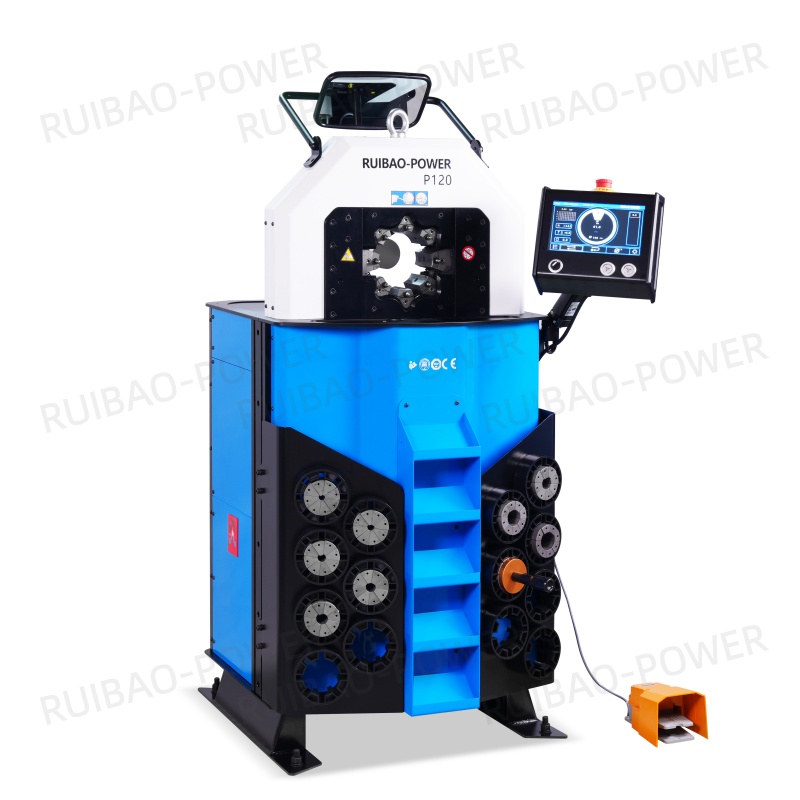
How to Correctly Choose a Hose Crimping Machine
Guide to Correct Crimping Machine Selection: Five Key Dimensions from Scenario Adaptation to Performance Matching
1. Identify Core Application Scenario: Matching Equipment Functionality with Operational Requirements
When selecting a crimping machine, you should first focus on the type of crimping object and production scale. The core categories and applicable scenarios are as follows:
For small and medium-volume flexible production (such as hydraulic hoses and pneumatic lines): Choose a semi-automatic crimping machine. This machine requires manual adjustment and is suitable for high-variety, small-batch repairs or customized production (such as construction machinery piping repairs), balancing flexibility and cost control.
For large-volume standardized production (such as automotive brake lines and air conditioning lines): Choose a fully automatic crimping machine. This machine automates the entire positioning and crimping process, reducing manual intervention and achieving a typical output of 10-30 pieces/minute, making it suitable for assembly line operations. For high-pressure/extra-large pipelines (such as oil pipelines and UHV projects), a dedicated heavy-duty pipe crimping machine equipped with high-strength dies and a pressure feedback system is required. This ensures the pipe withstands a pressure of ≥30 MPa after crimping, and is leak-proof and fatigue-resistant (e.g., crimping high-voltage cable connectors in power projects).
II. Key Performance Parameters: Three Key Indicators Determine Crimping Reliability
Crimp Force Range and Accuracy: Select equipment that matches the crimping force based on the pipe diameter (e.g., 6-51 mm) and material (rubber, metal, composite pipe). For example, crimping rigid metal pipes requires a crimping force of 50-500 tons, with a pressure control accuracy of ≤±1% to avoid loosening due to insufficient pressure or cracking due to overpressure.
Mold Compatibility and Changeover Efficiency: Verify the mold specifications supported by the machine, prioritizing quick-change mold systems (changeover time <3 minutes). This is especially true for high-volume production scenarios, where molds adaptable to different pipe diameters and interface types (e.g., flaring, shrinking, and corrugating) are required. Automation and Intelligence: High-end models may be equipped with a PLC control system and a touchscreen interface, supporting pre-set crimping parameters (such as pressure, stroke, and hold time), fault self-diagnosis (such as mold misalignment alarms), and real-time upload of crimping data to a management platform for quality traceability.
III. Material Compatibility: Avoiding Crimping Failures Due to Material Variations
Metal pipes (such as copper and aluminum pipes): Use a rigid crimping die to ensure the joint is free of wrinkles and deformation after crimping, and meet a tensile strength of ≥200N (referring to hydraulic pipe industry standards).
Flexible pipes (such as rubber hoses and plastic bellows): Use an elastic crimping die and a progressive crimping process to avoid excessive compression that could cause pipe wall rupture or seal failure.
Composite pipes (such as steel braided reinforced hoses): Use a multi-stage crimping process, pre-pressing the pipe to secure it, then applying pressure in stages to ensure the inner layer is sealed, the middle reinforcement layer is adhered, and the outer protective layer is intact. IV. Safety and Compliance: Mandatory Requirements for Reducing Production Risks
Safety Guards: A two-hand start button, infrared light curtain protection, and an emergency stop function are mandatory to prevent the operator's hands from entering the danger zone during the crimping process.
Industry Standard Certification: Equipment compliant with ISO 4413 (General Standard for Hydraulic Transmission Systems) or SAE J1401 (Automotive Pipe Connection Standard) is preferred to ensure that crimping quality meets the entry requirements of downstream industries (such as automotive and aviation).
Operational Ease: The equipment should be equipped with error-proofing features, such as automatic lockout when the mold model and pipe specifications do not match, to prevent product scrapping or equipment damage due to human error.
V. Typical Selection Mistakes and Pitfalls
Mistake 1: Blindly Pursuing High Automation
For small and medium-volume production, choosing a fully automatic machine will result in underutilization (increased idle costs). It is recommended to prioritize a semi-automatic machine, which can be upgraded later by adding an automatic feeder. Misconception 2: Ignoring Die Quality
Cheap dies are prone to wear and deformation, leading to dimensional deviations in the crimp (e.g., ovality > 0.1mm). It is recommended to choose heat-treated, hardened dies (hardness ≥ HRC55), which offer a service life of over 100,000 cycles.
Misconception 3: Ignoring After-Sales Service
A tube crimping machine is a precision machine. Ensure the manufacturer offers on-site installation and commissioning, free operator training, and a supply cycle of less than 7 days for consumable parts (such as seals and guide pins) to avoid downtime due to spare parts shortages.
Summary: Model Selection Decision Flowchart
Determine the Scenario → 2. Match the Crimping Force with the Die → 3. Verify Material Compatibility → 4. Assess Safety and Intelligence → 5. Compare Costs and After-Sales Service
By following these steps, you can accurately select a tube crimping machine, ensuring the crimped tubes have good sealing, high strength, and long life, while balancing production efficiency and long-term cost.
Safety Guards: A two-hand start button, infrared light curtain protection, and an emergency stop function are mandatory to prevent the operator's hands from entering the danger zone during the crimping process.
Industry Standard Certification: Equipment compliant with ISO 4413 (General Standard for Hydraulic Transmission Systems) or SAE J1401 (Automotive Pipe Connection Standard) is preferred to ensure that crimping quality meets the entry requirements of downstream industries (such as automotive and aviation).
Operational Ease: The equipment should be equipped with error-proofing features, such as automatic lockout when the mold model and pipe specifications do not match, to prevent product scrapping or equipment damage due to human error.
V. Typical Selection Mistakes and Pitfalls
Mistake 1: Blindly Pursuing High Automation
For small and medium-volume production, choosing a fully automatic machine will result in underutilization (increased idle costs). It is recommended to prioritize a semi-automatic machine, which can be upgraded later by adding an automatic feeder. Misconception 2: Ignoring Die Quality
Cheap dies are prone to wear and deformation, leading to dimensional deviations in the crimp (e.g., ovality > 0.1mm). It is recommended to choose heat-treated, hardened dies (hardness ≥ HRC55), which offer a service life of over 100,000 cycles.
Misconception 3: Ignoring After-Sales Service
A tube crimping machine is a precision machine. Ensure the manufacturer offers on-site installation and commissioning, free operator training, and a supply cycle of less than 7 days for consumable parts (such as seals and guide pins) to avoid downtime due to spare parts shortages.
Summary: Model Selection Decision Flowchart
Determine the Scenario → 2. Match the Crimping Force with the Die → 3. Verify Material Compatibility → 4. Assess Safety and Intelligence → 5. Compare Costs and After-Sales Service
By following these steps, you can accurately select a tube crimping machine, ensuring the crimped tubes have good sealing, high strength, and long life, while balancing production efficiency and long-term cost.
How to design an efficient and practical hydraulic hose crimping service vehicle


